Since their launch from Earth in 2003 not he back of a Delta II rocket I have followed the trials and tribulations of the twin Mars Rovers Spirit and Opportunity. Each Rover was designed to last 90 Sols on cold and desolate Martian surface. It is only now, 15 years later, that we are saying goodbye to Opportunity.
The Spirit rover was the first of the two to land on Mars in January of 2004 and the first to be declared end of mission in 2011 after getting stuck in soft Martian soil and having an unfavorable angle toward the sun for the solar panels to charge its batteries.
The Opportunity rover landed a few weeks after Spirit in late January 2004. Opportunity now holds the record for longest operating rover on Mars. After traveling over 26 miles during its 5,352 Sols (5,498 Earth Days) on Mars, Opportunity was declared end of mission on February 13, 2019. Putting an end to one of the greatest Mars missions to date.
While the true impact of the information that each rover has collected will take years to be processed and analyzed there are two images, one taken by Spirit and the other by Opportunity, that I believe are the most important of the whole mission. It goes beyond science and taps into the human perspective.
The first image is one that Spirit took as it looked up at what appeared as a bright evening star. That star was in fact Earth.
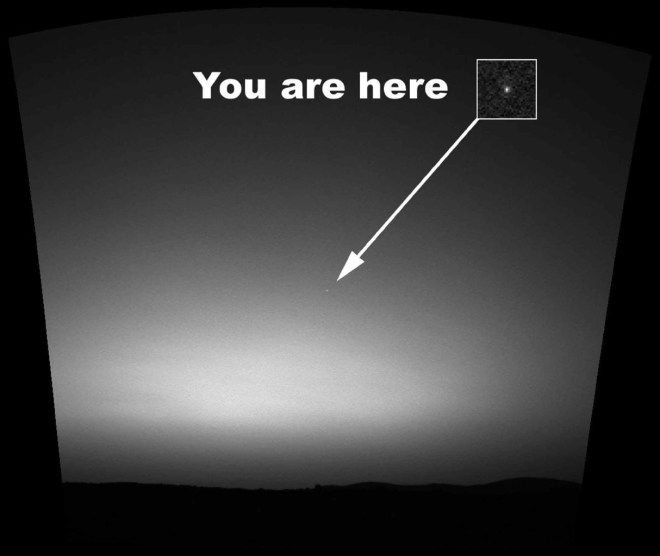
As I look at this image I am reminded of the words of Carl Sagan and an excerpt from his book “Pale Blue Dot”.
Look again at that dot. That’s here. That’s home. That’s us. On it everyone you love, everyone you know, everyone you ever heard of, every human being who ever was, lived out their lives. The aggregate of our joy and suffering, thousands of confident religions, ideologies, and economic doctrines, every hunter and forager, every hero and coward, every creator and destroyer of civilization, every king and peasant, every young couple in love, every mother and father, hopeful child, inventor and explorer, every teacher of morals, every corrupt politician, every “superstar,” every “supreme leader,” every saint and sinner in the history of our species lived there–on a mote of dust suspended in a sunbeam.
The Earth is a very small stage in a vast cosmic arena. Think of the rivers of blood spilled by all those generals and emperors so that, in glory and triumph, they could become the momentary masters of a fraction of a dot. Think of the endless cruelties visited by the inhabitants of one corner of this pixel on the scarcely distinguishable inhabitants of some other corner, how frequent their misunderstandings, how eager they are to kill one another, how fervent their hatreds.
Our posturings, our imagined self-importance, the delusion that we have some privileged position in the Universe, are challenged by this point of pale light. Our planet is a lonely speck in the great enveloping cosmic dark. In our obscurity, in all this vastness, there is no hint that help will come from elsewhere to save us from ourselves.
The Earth is the only world known so far to harbor life. There is nowhere else, at least in the near future, to which our species could migrate. Visit, yes. Settle, not yet. Like it or not, for the moment the Earth is where we make our stand.
It has been said that astronomy is a humbling and character-building experience. There is perhaps no better demonstration of the folly of human conceits than this distant image of our tiny world. To me, it underscores our responsibility to deal more kindly with one another, and to preserve and cherish the pale blue dot, the only home we’ve ever known.
— Carl Sagan, Pale Blue Dot, 1994
Copyright © 1994 by Carl Sagan, Copyright © 2006 by Democritus Properties, LLC.
All rights reserved including the rights of reproduction in whole or in part in any form.
While Carl Sagan’s “Pale Blue Dot” was inspired by the image of Earth from the Voyager space craft looking back at our solar system it still resonates with Spirits image as well. It should remind us of prospective and while humanity has done great things we should be humbled by our place in the universe.
The second image was taken by the Opportunity rover. After driving across the sandy plains of Meridiani Planum, Opportunity looked back and took a picture of the tracks it left in the sand.
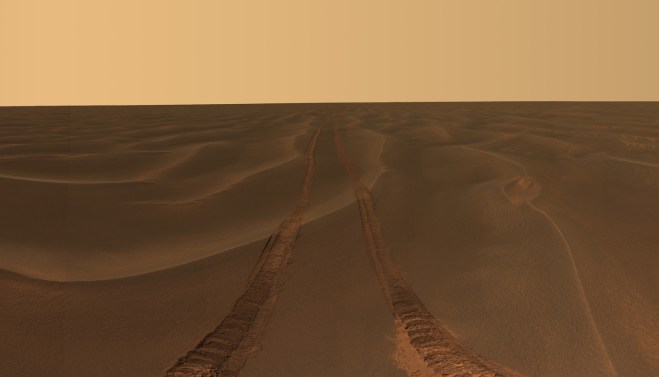
As a people we tend to constantly look forward, ignoring what is behind us, and go blindly into the light. This image should be a reminder to stop, take a minute, and look back at where we’ve been. All of those dunes we’ve climbed, some harder than others, some getting us a little stuck, but always that persistent push forward.
 Seth Houts